For my regular visitors, if you find that this blog hasn't been updating much lately, chances are pretty good I've been spending my writing energy on my companion blog. Feel free to pop over to Home is Where the Central Cardio-pulmonary Organ Is, and see what else has been going on.
Showing posts with label gender issues. Show all posts

Sunday, April 07, 2013

Apologetics Makes a Comeback Among Youth: Youth ministry sees the return of reasons.

Apologetics Makes a Comeback Among Youth: Youth ministry sees the return of reasons.

Challenging the cultural climate is a major component of the new apologetics, said Sean McDowell, head of Worldview Ministries. "The apologetics resurgence has been sparked ultimately by teens who are asking more questions about why people believe the things they do," he said. "Those who thought that kids in a postmodern world don't want an ideology were wrong."

 I've have been seeing some interesting cultural shifts of late, including among our youth and young adults.  It's something I've described seeing to people I've had debates with on various topics, but those I've mentioned it to do not see it.  I'm not surprised by that.  What they are seeing is what the mass media and certain alternative media that they follow want them to see.  They are seeing the results of popular polls and superficial trends.  In their eyes, religion is being destroyed by "science" and "rationality"; they see opinions towards SSM going in their direction, which they describe as "the right side of history" and other such meaningless catch phrases; they see the abortion issue as decided and beyond debate.  Everything around them is telling them that "their side" has won.

I follow enough of popular media to know what they are seeing - and who is telling it to them.  However, I follow both sides, and what I'm seeing is something very different.  Even as the mainstream media claims that the abortion debate is no debate at all, painting pro-lifers in the worst possible light, I am reading the blogs and articles and watching the videos of those who were there.  I am seeing the astonishing increase in people who are now openly and unwaveringly pro-life, even in the face of sometimes violent attacks from pro-abortion supporters.  In popular and social media, I see the assumption that people of science are all atheists, and the claims that religion is anti-science and ignorant.  The verbal attacks on those who hold religious views by those who claim to be "rational" and "scientists" are inevitably rude, crude, vile and completely unreasonable and unintellectual.  Meanwhile, I am seeing people of faith make polite, rational and evidentiary defences in the face of these attacks.  I read the papers, articles, books, blogs and reports written by men and women of both science and faith, and their careful claims blow away the irrationality of their attackers.  I am also seeing, in complete contradiction of the claims made by those who support SSM, a rise in support of traditional marriage - a rise based on logical argumentation, rationals discussion and evidence based claims.

In all cases, this shift that I am seeing is very much a grassroots thing, and the demographics are completely at odds with how the opposition portrays anyone who disagrees with them.  They are not the "old, rich white men of privilege" or "Christian bigots" and so on.  No, I'm seeing this shift happening across the board.  Men and women, rich and poor, of all colours, religions (or lack of them!), cultural backgrounds, even sexuality.

Most of all, however, I am seeing this shift increase among youth.  For all the social experimentation of our public schools, some youth are still managing to be exposed to both sides of issues.

And when they are, they are seeing through the politically correct shadows and lies, recognising truth for what it is, and taking a stand.


Wednesday, January 02, 2013

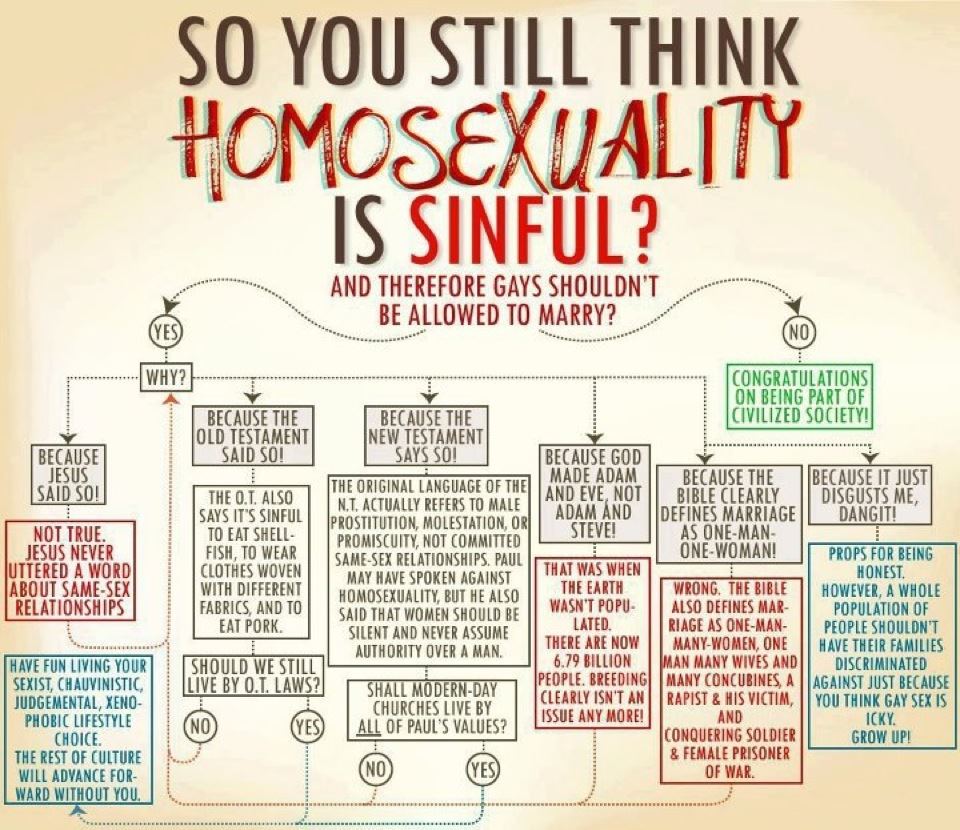
So you think Homosexuality is a sin...

So here's my first post of the New Year.  I had hoped for something a little more cheerful and uplifting, but other stuff beat me to it.  Still, I'd like to say first that I hope everyone visiting had a wonderful Christmas season (which isn't over for us until the 6th), that your New Year's celebrations were safe and happy, and that 2013 is a year of peace, health and prosperity.

For those of you in the US, I hope you somehow manage to survive what your president is doing to your country.  You have my hopes and prayers.

And now, off to controversial things!!

Recently, someone on my facebook friends list (someone I know through a group, so not a close friend) posted a graphic that I've seen a few times.  I find that, as the years go by, I have far less tolerance for stupidity, so I responded.  I would have posted the entire conversation as a screen cap, but it was disappeared before I could respond to the final comment.  I have my facebook set to email responses to me, so I have her comments, but my own were no longer accessible, so I will have to fill in as best as I can remember.

First, the graphic.


 Now, there are so many things wrong with this, it's mind boggling, but it's a popular one I've seen a few times.  Usually, it's shared as part of a group or something, with so many responses, I don't bother commenting because it would just be like spitting in the wind.  However, when I saw it again shared by this person (whom I've had conversations with on the topic of SSM in the past), I just rolled my eyes and left a comment.  To the best of my memory (and that of Eldest, who is my handy editor), I wrote:

"Wow.  There are so many misinterpretations/revisionisms of the Bible here, it's embarrassing."

I also made a comment about how this was a typical way of attacking the "enemy."

Being in a facebook comment, I didn't bother trying to tackle individual points, though I was willing to, if challenged.

To which she responded.


 Now, when I post something contentious on my newsfeed, I know that there are people who might disagree with me.  I know I am opening myself up to be challenged.  If I'm not up to that, I don't post it.  Full stop.  The idea that people post contentious things, expecting only to have people agree with them, then getting upset when someone doesn't, always startles me.  If you're not willing to defend what you've said or shared, why post at all?

So I responded (again, as best as I can remember):

"But you're still willing to post it.
Wait.  Are you actually justifying sharing something that misrepresents two major faiths and millions of people (not everyone who disagrees does so for religious reasons) because those faiths have already been misrepresented in the last 2000+ years (6000+, since it also references the Talmud), and that makes it okay?  Sharing something that insults such a large portion of the world's population should not be taken lightly, even on facebook. :-/"

Well, I guess she didn't appreciate that, because I soon got...


Obviously, she had some technical difficulties at the end, there.

I actually found this response hilarious.  She's accusing *me* of being judgemental, after sharing a graphic like this?  It is, however, a very typical response.  Rather then address the issue (misrepresentation of what the Bible actually says), she excused it ("...a little humorous"), justified it ("anything that gets people thinking..."), upped the emotionalism to attack ("...get off their judgemental asses..." etc.) and basically told me that, if I disagree, I should just shut up ("You don't have to read my post...").

I made a fairly long response after this.  I wish I could remember it better.  I pointed out that it was laughable for her to post something that is so judgemental and insulting of anyone who holds a differing point of view, takes all who disagree and shoves them under one umbrella, regardless of their actual reasons for disagreeing, then turns around and accuses the victims of said judgemental attitude of being judgemental.  I also wrote that 'I have long noticed that the most intolerant people are those who scream the most for tolerance.  This graphic is just another example of that.'  I'm paraphrasing as best I can here.  Somewhere in there, I also commented that it's possible to accept people for who they are, without agreeing to redefine our core institutions.

Her response?  Sadly, also very typical.


Yup.  She just leapt to equating disagreeing with her with being a racist.  Disagreeing with her means I'm delusional - though how that's supposed to make me feel better about anything, I have no idea.  Then, she projected all sorts of things onto me that had nothing at all to do with my original objections to the graphic.

As I said, typical.  Rather then address the actual objection, demonize the person objecting.

I had started to respond with a comment along the lines of how amazingly judgemental and intolerant her assumptions were, but I suddenly had to leave the computer.  Eldest asked if she could respond, as we had been discussing this together.  As she was writing, another comment appeared... this one.


So my daughter responded to both at once.  When I came back, I read over what she'd written, agreed with it.  She was kind enough to reproduce her response here.

 "It seems to me like you are very passionate and not particularly well studied on the subject at hand. If the beliefs you oppose are so horrible, what need is there to lie (or at the very least post a deliberately dishonest graphic) about them? The idea that the sinfulness of homosexuality is based on one line out of one book next to the virulent anti-shellfish rhetoric is just as silly as the idea that Christianity not accepting homosexual behavior means we want to relegate all the scary gay people into closets."

She never received this response.  When I hit post, it failed.  Yup, in the time it took to write the above, she unfriended me and, from what I could tell, removed the entire thread from her timeline.

Again, very typical.  I can't say I'm going to miss having her on my friends list, but I suspect it will make getting conversations in this group we're both a part of rather interesting.

While this is quoted from one person, her responses and reactions are so common, she could be any of a number of people I've seen try to justify their support for SSM.  They do it by first misrepresenting the "enemy".  For those who claim to be Christian, as this person does, they do it by redefining God (sorry, hun, but God specifically tells us to stand up against sin and, yes, be judgemental.  More on that later).  From past conversations, I know she holds to the version of God as a God of sunshine and butterflies that's really popular right now.

So let's deal with what this graphic is actually saying, point by point, without - hopefully - running on for too long.

The problems start right at the very top, with the double question.

"So you still think homosexuality is sinful?  And therefore gays shouldn't be allowed to marry?"

This is two different issues forced into one.  First, there's the sin part, with the word "still" in there.  Because apparently, that's not something anyone is supposed to believe anymore.  Then there's the use of the word homosexuality.

Let's be very clear about this.  When SSM supporters talk about homosexuality, they are not talking about the same thing as those who say homosexuality is a sin.   In the first part, they are talking about an identity.  In the second, they are talking about a behaviour.  This gets confusing, because people rarely add the word "behaviour" in there when talking about the sin of homosexuality.  This makes it easy for their detractors to turn around and say they "hate gays" - namely, people with same sex attractions, rather then people who engage in a specific sexual behaviour. (more on this later)

Then there's the second part - that thinking homosexual behaviour is a sin is the sole reason anyone objects to SSM.  In truth, people disagree with SSM for all sorts of reasons.  There are atheists, agnostics and gays who disagree with SSM, while there are religious people who believe homosexual behaviour is a sin, but do not think the state should prevent SSM.  There is no black and white, here.

Let's see if I can draw a parallel here.  Lying is a sin.  People who lie are called liars.  We do not define people who lie by their lies, unless their behaviour becomes excessive.  There are consequences to behaviour.  It is not against the law to lie EXCEPT in cases where lying has far ranging effects.  It is illegal to lie under oath in a court of law.  Such lying can land you in jail.  Similarly, homosexual behaviour is a sin.  It does not become a matter of law until people try to change those laws to validate their behaviour, and force the rest of society to condone said behaviour.  This is not a matter of equality.  The laws defining marriage applied to everyone equally.  One man, one woman, legally adult, not close blood relations.  This did not stop people from having relationships with each other.  This did not stop people from having sex with each other.  This did not stop people from loving each other.  The state recognised marriage as different for a purpose.

So the question itself is a problem.  The graphic then gives two choices; yes or no.  If you say no, you get a lovely "congratulations on being part of civilized society."

Here is the most in-your-face judgementalism of the graphic.  Either you agree with whoever made this, or you're not part of civilized society.  This sort of ad hominem attack is really common (right up there with equating people who disagree with racists).

If you say yes, it asks why, then sends you through the flow chart.

The first one is "because Jesus said so!" (complete with exclamation point!!!).  The graphic then claims:

"Not true.  Jesus never uttered a word about same-sex relationships."
 Of course he didn't.  He didn't have to.  What he did way was things like "Haven't you read," he replied, "that at the beginning the Creator 'made them male and female,'  and said, 'For this reason a man will leave his father and mother and be united to his wife, and the two will become one flesh'?  So they are no longer two, but one. Therefore what God has joined together, let man not separate." (Matthew 19:4-6) 

Jesus very clearly specified what marriage was.  He didn't need to spell out anything about "same-sex relationships."  That was already understood.

Which leads to another problem with the answer.  It says "same-sex relationships."  We're not actually talking about relationships between people of the same sex.  We are talking about a specific, sexually defined relationship that is recognised by state, society, religion and God as uniquely different from any other relationship. 

As for homosexual relationships, that is a modern invention that did not exist as a separate, labelled category, based on attraction rather than behaviour, until about 150 years ago.  People who say Jesus never said anything against homosexuals are being dishonest and misleading.  Yes, people engaged in what we now call homosexual acts, but until relatively recently, these acts were part of a long list of sexual acts that scriptures said were sinful, such as incest, adultery, fornication and bestiality.  The only non-sinful sexual behaviour was between a married couple with each other.

Let's move on to the next "why" response.  "Because the Old Testament said so!"

The graphic answers:

"The O.T. also says it's sinful to eat shell-fish, to wear clothes woven with different fabrics, and to eat pork."

It then asks:

"Should we still live by the O.T. laws?"

This part demonstrates common ignorance of what Leviticus actually says, and is quite misleading.  That's not even the beginning of what's wrong with it.

First, it avoids the "why" by distractions.  Rather then address whether or not that's what the OT actually says, it throws up other restrictions of what it defines as sinful behaviour, out of context, then says, "see!  If you do any of these, then you're a hypocrite, picking and choosing what sins are acceptable."  Assuming they are actually right about this, how that makes the sin of homosexual behaviour any *less* of a sin because people sin in other ways is illogical, but it scores emotional points, and people fall for it.  Mostly because they don't know what that part if the OT actually teaches.

First of all, the book of Leviticus was a book of laws for the Levites.  They were basically the Rabbis and teachers of Israel, and had specific duties to fulfill.  Some of these restrictions, such as wearing cloth of mixed fibres, were purely ceremonial.  A number of these sins had no punishment for disobedience at all.  They were largely a way for Jews to remain separate from the pagans that surrounded them   Laws regarding diets and sanitation applied only to Jews - if you weren't Jewish, they didn't apply to you.  They did, however, lead to Jews having life spans that were triple their gentile neighbours.

The laws put down in Leviticus covered three categories: moral, civil and ceremonial.  What the response in the graphic does is equal civil and ceremonial sins with moral ones.  This is dishonest and misleading.

For Christians, Jesus fulfilled the prophecies, thereby some of these laws no longer applied, such as the dietary laws, which he specifically mentioned.  However, Jesus also said "Do not think that I have come to abolish the Law or the Prophets; I have not come to abolish them but to fulfill them." (Matt. 5:17)  So if you're a Jew, all the OT laws still apply (choosing to obey them is something else).  For a Christian, all the laws apply except those where Jesus specifically said otherwise, such as when he responded to criticisms that some of his disciples were eating without having gone through the ceremonial washing by saying "There is nothing from without a man, that entering into him can defile him: but the things which come out of him, those are they that defile the man." (Mark 7:15)

With all this, the graphic is being completely dishonest, rendering its question "should we still live by OT laws?" irrelevant.

On to the next "why" response: "Because the New Testament so!"

Their response is"

"The original language of the NT actually refers to male prostitution, molestation or promiscuity, not committed same-sex relationships.  Paul may have spoken against homosexuality, but he also said that women should be silent and never assume authority over a man."

Then they ask (as if they satisfactorily responded to the objection in the first place) with:

"Shall modern-day churches live by all of Paul's values?"
Here, they've done the same thing as before, except with the added appeal to authority by saying "the original language," as if they've actually studied this.  Yes, the NT refers to male prostitution, etc., but to leap from that to saying there are NO objections to "committed same-sex relationships" is dishonest.  The NT is clear that marriage is between a man and a women, so there is no need to specify against anything else.  It then goes on to attack Paul (again, out of context, as it was referring to the structure of leadership within the fledgling church - Christianity actually played a huge part in elevating the status of women and children as being equal to men, since it taught that all humans were of equal value in the eyes of God), as if his writings about women has anything to do with SSM.  Also, it should be pointed out that Paul was not a prophet.  He was a theologian.  This renders the final question purely rhetorical and irrelevant.

Now, in the flowchart, if you still answered "yes" to the above statements, it takes you to final response:

"Have fun living your sexist, chauvinistic, judgemental, xenophobic lifestyle choice.  The rest of culture will advance forward without you."
See?  If you disagree with the maker of this graphic (and anyone who agrees enough to share it), which is full of false claims and misrepresentations, you are sexist, chauvinistic, judgemental and xenophobic!  How tolerant!  How non-judgemental!  How open minded and loving!

Yeah.  Right.


So what's next?  Ah, lovely.  "Because God made Adam and Eve, not Adam and Steve!"

That's a handy little catchphrase that I really wish people wouldn't use, but it does make the point that God created us, male and female, as partners, with the admonition to go forth and multiply.  Obviously, SS couples can't do that.

If this catchphrase is silly, their response, however, is even sillier.

"That was when the earth wasn't populated.  There are now 6.70 billion people.  Breeding clearly isn't an issue any more!"
 Wow.

Just...

Wow.

So here we come to a place within gay activism that many people try to pretend isn't there.  This is the place where heterosexuals are derided as "breeders."   It also reflects an increasingly common anti-human attitude that sees us as a virus; a plague on Mother Earth that needs to be cut back and controlled is Gaia is to survive.

I notice something else about it that's amusing.  The response tacitly agrees with Genesis creation of two humans, from whom we are all descended.

Either way, this statement saying that, because there are already so many people, breeding isn't an issue anymore, is irrelevant to the issue at hand, which is whether or not homosexual behaviour is a sin (according to the Bible, at least; they don't touch non-Biblical religions that also object to homosexual behaviour at all).  Their response is another distraction and irrelevant.

What's next?  "Because the Bible clearly defines marriage as one-man-one-woman!"

Their response:

"Wrong.  The Bible also defines marriage as one-man-many-women, one man many wives and concubines, a rapist & his victim and conquering soldier & female prisoner of war."
*sigh*

Okay.  Let's point something out here.  The Bible isn't just a book about Things We Ought to Do.  It's also a record of when God's chosen people messed up.  Horribly.  It records people doing nasty, nasty things to each other.  It also relates specific instances where people were commanded to do certain things.  Those commands were not things to be applied generally, to all and future generations, but to those specific instances.

One of the things that defined whether or not a couple were married was consummation of that marriage.  It was the sex act itself, not any ceremony of priestly blessing, that decided if a man and woman were married.  The roles of men and women were defined.  Part of that was the responsibility of men to provide for and protect their wives.  Let's take the rape victim for an example.  In the ancient world, technically, the sex act meant they were married, voluntary or not.  Meanwhile, the victim would be less valued and have difficulty finding a husband to provide for her in the proper way.  She would be damaged goods.  Sadly, this attitude is still with us today.  The victim suffers for the rest of her life, while the man gets to go on his merry way.

Most people see this demand of men to marry their rape victims as some sort of punishment for the woman, and a boon to the man.  What they're missing is that this is actually a punishment for the man, while ensuring his victim is provided for for the rest of her life.  The man, forced to marry his victim, is the acknowledged perpetrator of a great crime.  He will be required to provide for his victim for the rest of his life.  It's hardly an ideal situation for either of them, but at least the victim will not suffer the cultural consequences of the man's crime.  Meanwhile, couples are admonished to love each other - this is a behaviour, not an emotion. 

Likewise, with prisoners of war, the men would have been killed.  That left the women without providers and protectors.  Again, not an ideal situation, but better then slow death by starvation, animal attacks or attacks from other humans.

The ancient world was a brutal, bloody place. 

This is a good time to remind everyone that the purpose of marriage has never had anything to do with being in love or acknowledging loving relationships. 

The point, however, is that the Bible does indeed define marriage as between one man and one woman.  It's also a record of people who were constantly disobeying God.  I mean seriously; we're talking about a world where God had to explicitly and repeatedly tell His People to not have sex with animals, stop sacrificing their children to Molech and oh... Ladies?  When you're on your cycle, it's really a good idea not to bleed all over the place.

The Bible defines marriage very clearly.  That people didn't obey doesn't change that definition.  If we are going to examine the Bible and what it says, we have to look at it through the time period and context it deals with, not project our modern sensibilities and interpretations onto it.

And now, finally, we reach the final "why" response.  "Because it just disgusts me, dangit!"

Throwing in that "dangit" was a nice, not-at-all-trying-to-influence-the-reader addition.

Their response?

"Props for being honest.  However, a whole population of people shouldn't have their families discriminated against just because you think gay sex is icky.  Grow up!"
Riiiiggghhhttt.

First, that "whole population" is a tiny minority, and those who support SSM are an minority within a minority.  Did you know that, early in the gay rights movement (back when they fought against real discrimination, like being fired from their jobs for being gay, or being violently attacked, etc), when people suggested that someday they would be demanding gay marriage, early activists scoffed at the notion?  These early activists didn't want SSM.  Some because they acknowledged the role of marriage in society and agreed that it was a heterosexual institution.  Others because, being a heterosexual institution that was increasingly being attacked on all sides (such as from militant feminism), they wanted nothing to do with it.  Marriage, they claimed, should be left to the breeders.

Oh, how things have changed!

Where else does this statement go wrong?  By saying this minority "shouldn't have their family discriminated against..."

Excuse me, but if the requirements of marriage apply to all people, equally, how are homosexuals - and their families - being discriminated against in any way that's different from, say, siblings who want to marry?  Or underage children?  Marriage is an institution that has qualifications.

This is where the attempt to equate objections to SSM and racism falls apart.  The definition of marriage is based on gender and blood relation (or lack of it), not race or ethnicity.  Race is irrelevant to the basic purpose and role of marriage within society, therefore, laws that restricted marriage based on race were, obviously, racist and rightfully overturned.  SSM, however, runs counter to the basic purpose of marriage.  Its existence in those places that have legalized SSM has caused mind boggling new problems that no one ever expected, ranging from rendering biological parenthood extremely complicated (recent court cases include 3-parent laws in the making, and a sperm donor being forced by the courts to provide child support, even though the lesbian couple involved have never asked for it and are fighting in his defence against it) to rendering marriage and parenthood itself, and by extension, all married couples and parents, married or otherwise, genderless (we are no longer legally husband or wife, but spouse 1 and spouse 2; we are no longer mother or father, but parent 1, 2, 3 or 4).  The problems with legalizing SSM are just beginning to show, and it may take a full generation or two before the damage is fully realized.

Which brings me to a final point about this graphic.  In its attack on defining homosexuality as a sin (without differentiating between identify and behaviour), it never fully answers the second part of its double question, which deals with "allowing" SSM.  What the maker of this graphic is skirting around is that it's not just a simple matter of "allowing" SSM or not.  It does nothing to explain why we should legally redefine marriage to validate the SS relationships.  It does nothing to explain why believing homosexual behaviour is a sin has anything to do why we should or shouldn't "allow" SSM at all.

This graphic attacks those with opposing opinions, first by misrepresenting the objections, then through responses of misrepresentation, mockery and judgemental insults.

Now, tell me again; which side of the debate is being judgemental and intolerant?

Oh, wait... in order for there to be a debate, both sides have to be willing to put forward arguments and rebuttals.

Never mind.


Friday, October 26, 2012

Men Don’t Mother | Public Discourse

Men Don’t Mother | Public Discourse

So what do the decades of research on fathers say? Boys from fatherless families are twice as likely to end up in prison before age 30. Girls raised in homes without their fathers are much more likely to engage in early sexual behavior and end up pregnant as teenagers—for example, girls whose fathers left home before their daughters turned six are six times more likely to end up pregnant as teenagers. Children who grow up without married mothers and fathers are also more likely to experience depression, behavioral problems, and school expulsion.
There is also more abuse in homes without fathers. In studies of physical, sexual, and emotional abuse, fathers living with their children emerge as strong protectors—both through watching over their children’s activities and communicating to others that they will protect them. In one study, abuse was 10 times more likely for children in homes with their mother and an unrelated boyfriend.

h/t Big Blue Wave

Tuesday, January 10, 2012

What people see

An atheist friend shared a graphic recently.  It portrayed what people see when they first get to know someone (nice words like kind, friendly, etc surround a line drawing of a person), then what they see when they find out that person is atheist (nice words replaced with nasty ones, as well as words like depressed, lost, confused, etc.).

I don't doubt her experience.  It's unfortunate that it happens, though when I showed it to my daughter, her response was "people don't necessarily think that *because* they are athiests."  She has a point, too.  There are atheists like my friend, and then there are ... the other kind.

I get what she's saying, though.  I get it, too, though obviously not because I'm atheist.

Then, my wonderfully talented daughter drew this for me to illustrate.


*snerk*

Extra snerk when we were adjusting the image on the computer and she added a potential caption of, "I'll bet those kids are home schooled!"

Oh, and in case you have trouble reading the text, the book reads "Sky Faerie Handbook," the big sign read "G*D HATES FAGS and foreigners are taking our jobs" with "Science is SIN" taped to one side and "1%" taped to the other.  Taped to the older daughter is a sign that reads "Future Mom."

The pistol dangling out of her pocket was a nice touch, as are the melon boobies on the little girl's doll. 

LOL!  Thanks, Sweetie.

update:  Wow!  Thanks, Blazing Cat Fur, for the plug and the traffic. :-)  I hope you all have enjoyed your visit.

If anyone would like to see more of my talented daugther's work, you can see some of it here, including her new online comic.

Monday, January 02, 2012

Non-judgemental Judging

In the last while, I've seen an interesting article being passed around.  Those who pass it on often include comments about how great it is, and if only everyone did this, or how glad they are that they've raised their own children this way, etc.

When I read the piece myself, I wanted to like it.  I really, really did.  It dealt with things that I see as major issues when it comes to how messed up our culture is when it comes to gender stereotyping.  In the end, however, I couldn't.  The article bothered me.  I read it again to try and pinpoint exactly what it was that bothered me about it.  Here is the link for you to read.  See if you can spot it yourself.

It's Ok to Be Neither; One Teacher's Approach to preventing gender bullying in a classroom

It's an interesting situation, but can you spot the problem?  I mean, besides the fact that Will Smith's son isn't named Trey, but Jaden (perhaps she meant the character's name, Dre).

Keep in mind, through all this, that we are talking about a child in first grade, which means she's about 6 years old.

For me, the problem is encapsulated in the following statement.

I have just begun to empathize with the challenges that gender-variant children deal with. For some it may seem inappropriate to address these issues in the classroom. My job is not to answer the questions “Why?” or “How?” Allie is the way she is (although asking those questions and doing some research in order to better understand was definitely part of my process). My job is not to judge, but to teach...

This teacher says it isn't her job to judge, yet that is exactly what she had done.  Little Allie, you see, is "gender variant" because she likes "boy" things.  The very concept of gender variance can only exist through gender stereotyping.  Though she devotes such effort to make Allie feel comfortable, she continues to make gender based assumptions and project them onto Allie. 

Let me explain.

The article beings by talking about Allie refusing to take off her hood in class.  It turns out to be because of her hair being in a ponytail instead of braids.  The teacher braids her hair for her.  Problem solved, right?

Nope.  Apparently, her wanting braids instead of a ponytail is part of what makes Allie "different" from other girls. 

The article is filled with all sorts of weird, inadvertently judgemental statements.  Let's start with this one.

Allison was biologically a girl but felt more comfortable wearing Tony Hawk long-sleeved T-shirts, baggy jeans, and black tennis shoes.

Excuse me, but what the hell is the connection between being "biologically a girl" and being more comfortable in t-shirts, baggy jeans or tennis shoes?  Right here, the teacher is the one being judgemental, as though her clothing choices were somehow a contradiction to her being "biologically a girl."

Her parents were accepting and supportive.
Of what?  The fact that she likes to wear practical clothing?  Good for them!  That's what 6 year olds SHOULD be wearing.  What the heck is she supposed to be wearing?  Little kids need to be wearing clothes that allow them to run and play and move around in comfortably.  Granted, it can be hard to find such clothes in the girls clothing section.  That's why we bought our daughters' clothes from the boys section.  It makes me wonder what the other girls in the class are wearing that makes little Allie's clothes so unusual.
Her mother braided her hair in cornrows because Allie thought it made her look like Will Smith’s son, Trey, in the remake of The Karate Kid.


Image source
This is what Jaden Smith looked like, at the time Karate Kid was made.  If this girl looks like that, I'd say she's very pretty!  As a prepubescent boy, Jaden (note the gender neutral name; does that make him gender variant, too?) could easily have been mistaken for a girl.  That's the thing with little kids.  Until puberty, there's very little difference in overall body shape between girls and boys.  With Allie being only in first grade, the differences would be even less obvious.

The main point, however, is that Allie liked her braids in cornrows because she thought it made her look like Jaden Smith.  Awesome!  She has good taste.

Oh, wait...  Jaden Smith is a boy.  Allie wanting to look like him is part of her problem. 


Back to the article.

She preferred to be called Allie.
Uhm.

So?

Wait.  Is Allie supposed to be a boy's name?  Because this is apparently another sign of little Allie's deviance "gender variance."  Does this mean that every Samantha the likes to be called Sam, or Nicole that likes to be called Nic, etc. is, in this teacher's eyes, "gender variant?"  I've met women named Gay.  I've met one who used the name Sissy.  If using Allie instead of Allison makes this child gender variant, what do these people's names make them?

The first day of school, children who hadn’t been in Allie’s class in kindergarten referred to her as “he.”

Okay.  Kids who didn't already know Allie mistakenly thought she was a boy.  Since there's so little physical difference between boys and girls in first grade, we'll have to assume it's because of Allie's clothing and preferring to be called Allie instead of Allison.  To me, the solution is simple.  Correct them.  If they have a problem with that, then deal with their rudeness.


I didn’t want to assume I knew how Allie wanted me to respond to the continual gender mistakes, 
 Wait.  What?  She's 6 years old.  How many 6 year olds can even articulate the sorts of gender concepts this teacher is talking about? 

so I made a phone call home and Allie’s mom put me on speakerphone.

 *facepalm*

Oh, that poor child. She must have felt so horrible.  Bad enough the teacher calling her at home with something like this, but to have to answer her on the speakerphone in front of her mother?  How humiliating!  Does this teacher not remember what it's like to be 6 years old?

“Allie,” she said, “Ms. Melissa is on the phone. She would like to know if you want her to correct your classmates when they say you are a boy, or if you would rather that she just doesn’t say anything.”
Allie was shy on the phone. “Um . . .
tell them that I am a girl,” she whispered.

Here we have a major part of the problem.  At 6 years old, Allie probably isn't thinking very much about gender issues, but she is very clear about one thing.  She's a girl.  She knows she's a girl.  Now, for possibly the first time in her life, she's encountering the idea that there might be something wrong with that, or that there's something wrong with her.  It's bad enough that she's got kids in school mistaking her for a boy.  Now she's got a teacher calling her at home with the suggestion that hey, maybe they're right.  Gee, Allie.  You look so much like a boy, the other 6 yr olds in class that don't know you think you are one, therefore you might actually want to be called a boy.  

How does that even make sense?
 
The next day when I corrected classmates and told them that Allie was a girl, they asked her a lot of questions that she wasn’t prepared for: “Why do you look like a boy?” “If you’re a girl, why do you always wear boys’ clothes?” Some even told her that she wasn’t supposed to wear boys’ clothes if she was a girl.

Holy Smokes!  This woman has got some rude kids in her classroom.   Where these kids born in a barn, or what?  Sheesh!  Teach them some manners!
 
It became evident that I would have to address gender directly in order to make the classroom environment more comfortable for Allie and to squash the gender stereotypes that my 1st graders had absorbed in their short lives.

Wait.  What?

You know, it seems to me that the only person here who *doesn't* have a problem with gender issues is Allie.  Her teacher sure seems to want to project all sorts of gender problems rather then deal with the general rudeness of her other students.

For the next while, the teacher writes about the different things she did to challenge these gender stereotypes.  As I read them, I find myself reeling from agreeing with her to wanting to scream at her for making the problem worse.  She spends so much time making a big deal about gender.  In her efforts to say it's okay for boys to like pink or girls to like Hot Wheels, she has highlighted, rather then neutralized, the gendering of things, then projecting the gender of those things onto the children who prefer them over other things.

She does bring out an interesting issue, which is just how strongly our culture genders things. The most ridiculous things are being marketed in gendered ways.  It may make sense from a monetary point of view for a company to market a "boys" toy tool kit in realistic colours, while a "girls" tool kit will be in pinks, but at least the girls are getting a tool kit marketed to them. You'd think, after all this time, we wouldn't have blue "doctor" kits for boys and pink "nurse" kits for girls.  It's no better when items marketed for adults are also gendered.

As the mother of two daughters, one of my biggest peeves was overtly gendered toys, but even that didn't bother me as much as the differences in clothing between boys and girls.  Girls clothes weren't just brightly coloured and flowery.  They were pretty much useless.  They were made with fabrics that weren't at all sturdy, had frills and flounces that caught on things, and were more about fashion and style then comfort or practicality.  And the shoes!  The most insane thing I ever saw was high heeled sandals FOR BABIES!!  Girls shoes - even those that were supposed to be runners - were little more then decorations.  They were designed to mince around in and show off.  Running in them would be dangerous.

The solution was simple.  By buying my girls their clothes in the boys department, I could get them comfortable, practical clothing they didn't have to worry about tripping, tearing or getting dirty.  I got them shoes they could run in.  They could climb trees, hang upside down, run and jump to their hearts content.  This allowed them to be active, healthy children.  As for the pretty, frilly stuff?  Yeah, they had some of those, too (mostly hand-me-downs or gifts), and they wore them when the occasion warranted.

This did not make them "gender variant."

Then this teacher takes the whole thing one step further.

It's not about gender after all, you see.  It's about sexuality.  Because they're one and the same.  Or something.

Then I guided the direction of the conversation toward gender. As a class, we brainstormed a list of things that students thought were “OK” even though they might challenge society’s gender norms. Monica told us very matter-of-factly, “It’s OK for a girl to marry a girl,” and Jordan said, “My dad carries a purse and that’s OK!” At that point I explained that my father and my friend Wayne both call their man purse a “murse.” The children were fascinated.
...

Afterward, I had the students do a simple write-and-respond exercise. I asked them to pick one activity that they associated with girls and one associated with boys to write about and illustrate. Monica drew two brides in beautiful wedding gowns. Miguel drew a man with a purse slung over his shoulder.
 Bolding is mine.

We'll ignore for a moment that purses started off as something men carried.  According to this, there's no difference between girls marrying each other, and men carrying purses. While dealing with gender stereotypes, this teacher has made the leap to sexuality.  The students haven't.  These are six year olds.  They probably don't have much notion about the sexual nature of marriage.  To the teacher, by using these as examples (and clearly she saw no need to clarify this with her students), challenging the gendering of things is on the same playing field as same sex marriage.  A girl's bride is equal to a man's purse.  A gendered accessory.

Although things were getting better for Allie, she still faced many challenges. At the end of the school year, Allie’s mother told me a heartbreaking story. She said that for Allie’s recent birthday party, her grandmother had bought her colorful, formfitting clothes and then demanded them back when Allie did not like them. “Does she know she is a girl?” she yelled, and announced she would never buy her clothes again.
In this quote, Allie's grandmother is the bad guy for being upset Allie doesn't like the clothes Grandma bought for her, and yelling "does she know she is a girl?"  As we saw above, clearly Allie knows she's a girl.  She's just a girl who happens to like comfortable clothes.  We are to view the grandmother in a negative light because of this; fair enough.  But is this teacher any better for not accepting Allie's own assertion that she is, indeed, a girl, and not "gender variant?"


In her effort to battle gender stereotyping, this teacher is teaching her students that "it's okay to be different."  And she's right.  She's teaching her students that it's okay for boys to like dolls and girls to like cars.  And she's right.  Where she fails is in her insistence that any of this has to do with her students' gender or sexuality.  The very title of the piece, "It's Ok to Be Neither" exemplifies this.  It's okay to be a boy.  It's okay to be a girl.  But because Allie is a girl who likes "boy" things, this teacher has judged her to be neither.  "My job is not to answer the questions “Why?” or “How?” Allie is the way she is..." writes the teacher, and in saying this, she demonstrates that for all her efforts to be make Allie feel comfortable, it is clear that in this teacher's mind, there is something "different" with Allie.  "The way she is" is somehow not normal, different, gender variant.  Little 6 yr old Allie isn't free to be a girl who likes boys things.  She has been labelled and denied her own gender.

This bothers me.  A lot.  It also makes me very glad I am not a child growing up today.

Allie, you see, is a lot like me.  As a child, I hated "girl" things.  I hated dolls, but loved playing with bricks and cars.  My mother and I fought for years as she tried to stuff me into skirts and dresses.  I did keep my hair long, but it was more to spite my mother who, for some reason I never quite understood, insisted I should keep it short.  I wore boyish clothes and loved to slog in ditches and climb trees.  Yes, I even got mistaken for a boy as a child.  Though I knew the things I liked there "boy" things, and I revelled in being a "tomboy," the idea that I might actually be a boy because I liked them was unheard of.  In today's world, however, my enjoyment of such things would have people questioning my sexuality.  Not only that but, in our current culture, liking boy things means being "gender variant" and that I might not actually be a girl.

Which would be a real surprise to my husband.

Still, these children are learning that it's okay to be different.  They're learning that it's okay for boys to like dolls and girls to like trucks.  How can this be a bad thing?

If that's all it was, it wouldn't be a problem.  But that's not what's happening.  Allie, you see, is not a girl who likes boy things, and that's okay.  Allie is a girl who has been judged "gender variant" because she likes boy things.  The gender stereotypes are still in play, but what has changed is that now, Allie is no longer a girl.  She is "biologically a girl."  She is "gender variant."  She is "neither." Allie is not "okay" for who she is.  She is "okay" for what her teacher has labelled her as.

There is a difference, and it can have significant consequences.  Allie is just 6 years old.  What will this mean for her when she gets older?

Let me give some examples.

Eldest's best friend, Raider King, is a pretty awesome young man.  Thankfully, he's also a fairly level headed and self assured young man.  He is also a young man who dyed his hair bright pink.  He uses a lacy, fuzzy pink scarf Youngest made for him.  He sometimes wears nail polish.

Based on gender stereotyping, Raider King should be gay.  His own mother thinks he's gay.  He gets hit on by other men regularly.  With our current culture, as we insist that it's okay for men to like girly things, instead of just saying "he's a man who likes pink and wears nail polish," he is more likely to be told he MUST be gay, or at least bi, because he likes girly things.  His sexuality is constantly called to question based on our culture's gendering of such things as colour, make up and accessories.  He has no problem laughing it off and just carries on.  Good for him!

His girlfriend is not so lucky.  I'll call her Southern Belle here.

Though she is older then him, she is not as self assured.  In fact, she's downright confused.  She went through a school system much like Allie is going through right now.  The result?  Southern Belle has no idea what she is.  She is mostly convinced that she is a gay male trapped in a female body.  Why?  Because she likes boy things.  You see, things have binary genders.  Liking trucks and wearing pants is boy stuff, while liking dolls and dresses is girl stuff.  People, however, are not considered binary gendered anymore.  The word "gender" no longer refers to our sex, but how we think of ourselves in relation to sexuality.  Gender is now viewed as a sliding scale, and since gender is now associated with sexuality and behaviour rather then our physical bodies, girls who like boy things aren't really girls.  They're something else.  They're more boy than girl.  Or maybe boy AND girl.  Southern Belle, however, is not sexually attracted to other women.  She's sexually attracted to men.  Since, on the sliding scale, she isn't really a woman because she likes "boy" things, that must mean she's actually a man inside, and since she is sexually attracted to men and not women, that means she's actually a gay man.  In a woman's body.  So how does she deal with it?  She blogs a lot about her issues, refers to herself in both male and female pronouns, and writes a lot of gay porn fan fiction.  She is obsessed and tormented by her sexuality, and trying to figure out what it is.

No one told Southern Belle as she was growing up that it was okay to be a girl who likes boy things.  She grew up being told that being a girl and liking boy things made her different; made her not quite a girl, but not quite a boy, either.  She is in absolute psychological torment because of it.  This gender confusion of hers has been inflicted on her by the same culture little Allie is growing up in, along with all her classmates. 

To Allie's teacher, I would say this.  Stop labelling Allie.  Stop projecting your gender issues onto her.  Let her be a girl who likes to wear pants and hoodies.  Let her be a girl who likes to wear tennis shoes.  Stop inferring the sexuality of your students because of gender stereotypes associated with their clothes or toys.  They are boys and girls, and they can like whatever toys or clothes or colours they want.  If you really want to fight gender stereotypes, disassociate gender from these things, not from your students.  Your students are boys and girls.  They know they are boys and girls.  That is not a stereotype and does not need to be challenged.  If they have problems recognising their classmates as boys and girls, correct them.  If they are rude, deal with the rudeness.  Stop assigning gender to their behaviour.  You've skirted the edges of the solution, but you don't seem to realize that by labelling them things like "gender variant," you are in fact highlighting that there is something odd about a girl liking to wear pants or a boy liking a doll. 

If you really want to challenge gender stereotypes, touchy feely storybooks about how boys do girl things and girls do boy things, and that's okay! is not the way to do it.  The way to do it is to challenge the gender stereotype.  Purses are a girl thing?  Tell them about how men used to carry purses all the time, but women didn't.  Pink is a girl colour while blue is a boy colour?   Tell them about how pink started off as a boy colour while blue was considered a girl colour.  If they think of clothing styles as being boy or girl things, show them some historical fashions, such as the tunics, togas, robes, kilts, powdered wigs, lace cuffs, ruffs, and high heeled shoes.  Do they think extreme sports are boy things?  Show them some ancient pottery depicting women jumping bulls.  Or find examples of how things in North America might be gendered one way, but in other cultures they are gendered differently. 

By dealing directly with the stereotype, not only will you challenge their assumptions, but you will be teaching them how these stereotypes are the result of cultures, fads and trends.  Toys or clothes are not gendered because they have a gender of their own, like our bodies, but because cultures have somehow evolved to view them that way.  In the process of challenging their gender stereotypes, you'll also be teaching them history, sociology and so much more.  A 6 year old may not be able to understand the sexual connotations behind gender issues, but they can understand that clothing styles can change, or that what is understood one way in their culture might be understood differently in another.

Most importantly, the gendering of toys and cloths and other things has nothing to do with their own gender.  Their physical bodies are what they are, and their gender is not determined by things like toys or clothes.